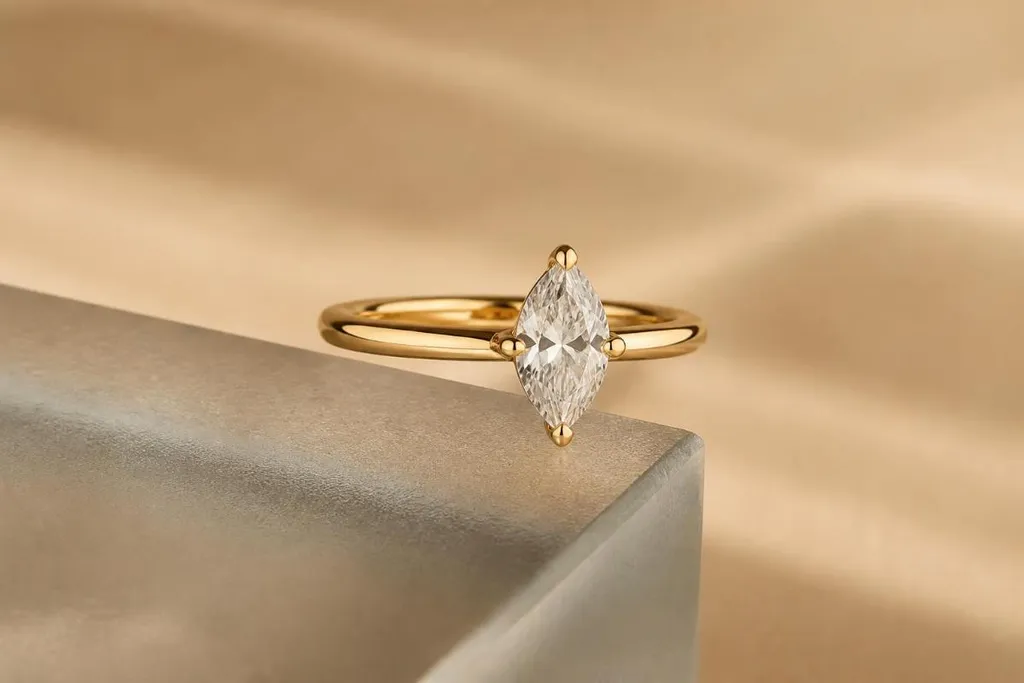
The marquise diamond is difficult to mistake for any other shape. With an elongated body that tapers to a point at both ends, it creates a strong line along the finger and a sense of presence that can feel surprisingly elegant rather than excessive. Its distinctive outline also means proportion matters enormously: small differences in length, width and symmetry can noticeably change the character of the ring.
Exploring beautiful lab diamond marquise cut rings highlights how versatile the shape can be when paired with thoughtful settings. A slender marquise can feel refined and contemporary, while a fuller stone offers a bolder silhouette. The objective is not to pursue maximum length or carat weight, but to find a diamond whose dimensions and setting feel naturally balanced on the hand.
Finding the Right Length-to-Width Balance
Length-to-width ratio is particularly important with marquise diamonds because it determines whether the stone appears slender, full or somewhere between the two.
A longer, narrower marquise creates a pronounced vertical line and can visually lengthen the finger. A broader stone has greater width through its centre, giving it a more substantial appearance. Neither proportion is universally preferable; personal taste and hand shape should guide the decision.
Symmetry is equally significant. The two pointed ends should align neatly with the centre of the stone, while the curved sides should mirror one another. Because the outline is so defined, unevenness can be easier to detect than it might be in a less directional shape.
The transition from the widest section into each point should also look smooth. Ideally, the silhouette feels graceful and deliberate rather than excessively narrow at either end.
Why Carat Weight Can Be Misleading
Marquise diamonds can offer impressive face-up coverage because their weight is distributed across an elongated shape. This makes actual measurements especially useful when comparing stones. Two marquise lab diamonds with similar carat weights may have different lengths, widths and depths. One could appear noticeably larger from above despite weighing essentially the same.
This also changes how buyers might think about a 1-carat versus a 2-carat diamond. Someone may prefer a 2-carat marquise because its proportions create the dramatic finger coverage they want, particularly on a larger hand. Another wearer may deliberately choose a smaller stone because the naturally elongated silhouette already provides sufficient presence.
Carat weight should therefore be considered alongside dimensions rather than treated as the primary measure of visual impact.
Choose a Setting That Protects the Shape
The pointed ends give the marquise its character, but they are also areas that require careful protection. A thoughtfully designed setting should secure both tips while allowing the distinctive outline to remain visible. A solitaire is particularly effective because it gives the marquise room to define the entire composition. A fine band can accentuate the diamond's length, while a slightly broader band creates a more substantial balance.
Diamond-set shoulders add brilliance without necessarily competing with the centre stone. Halo settings create a more decorative effect and expand the marquise outline, while a hidden halo can introduce additional detail beneath the stone without significantly changing its appearance from above.
Setting height deserves practical consideration as well. A higher profile may make the centre diamond feel more prominent, whereas someone who regularly works with their hands may favour a more streamlined construction.
Pay Attention to Light and Overall Styling
Like other elongated brilliant cuts, a marquise can display a bow-tie effect—a darker area across the central portion of the diamond. Some contrast contributes to the pattern and depth of the stone, but an overly dark bow tie can interrupt its brightness.
Visual assessment is therefore valuable. Specifications and grading information provide important guidance, but they cannot completely communicate how evenly an individual diamond handles light. Metal choice further shapes the finished aesthetic. Platinum and white gold can create a crisp, seamless backdrop, while yellow gold introduces warmer contrast. Rose gold can soften the sharpness of the two points and give the ring a more romantic character.
Wedding-band compatibility should also be considered, particularly with settings whose galleries or lower profiles may affect how closely another ring can sit alongside them.
Final Thought
Marquise lab diamond rings derive their appeal from proportion. Their elongated silhouette can create remarkable presence and graceful finger coverage, but those qualities depend on balanced curves, aligned points and thoughtful dimensions.
Rather than choosing by carat weight alone, compare the stone's length-to-width relationship, symmetry, light performance and setting. When each element supports the others, the marquise becomes more than an unusual diamond shape it offers a confident, elegant engagement style with a character entirely its own.